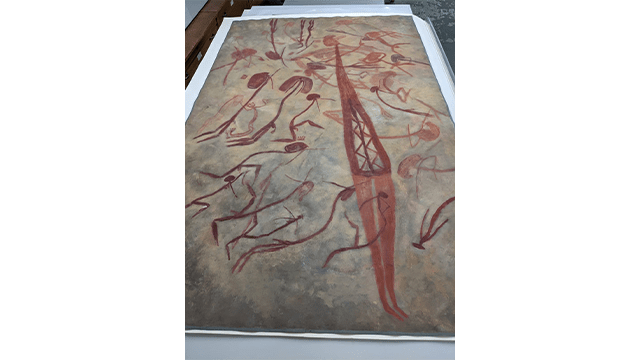
Artistic reproduction of Western Arnhem Land rock art, Agnes S. Schulz, Frobenius Institute, Goethe University Frankfurt am Main
In June 1954, Agnes Susanne Schulz, a member of the Frobenius Institute in Frankfurt am Main, Germany, travelled to the Northern Territory, where, over a period of nearly two years, she recorded rock art, cultural knowledge and practices, and collected material culture of local Aboriginal peoples of the Manilakarr, Mirrar Erre, Bunitj and Mandjurlngunj Clan Estates of western Arnhem and Kakadu. Here, for the first time, we describe in English Schulz’s expedition activities, outlining the places she visited and recorded and the peoples she met, including the names and descriptions of the relationships she formed with local Aboriginal people on Country. We also describe our collaborative community-led research methodology and the preliminary community responses to the collection and the research findings. This project offers insights into the tensions and risks involved for participating source communities in reengaging with historic and ethnographic collections assembled in colonial contexts. It also highlights the potential benefits of this kind of research to First Nations communities, as the research collaboration can provide a platform of activism for the reclamation of cultural heritage, and a mechanism to reconnect to kin.
This work is co-authored by Tristen Jones, University of Sydney; Richard Kuba, Frobenius Institute, Goethe University Frankfurt am Main; Martin Porr, University of Western Australia, and Alfred Nayinggul, Senior Traditional Owner, Manilakarr Clan Estate, Arnhem Land. It will be presented by Dr. Tristen Jones.
Dr Tristen Jones is a lecturer in the Master of Museum and Heritage Studies program. Her main research interests are Australian Indigenous archaeology and heritage, with a focus on rock art, cultural landscapes, material culture and museum collections. Recently, Tristen has worked on developing Indigenous-led research, knowledge sharing and teaching partnerships in tertiary education with Australian Indigenous communities as part of the ANU Indigenous Health and Wellbeing Grand Challenge. Her most recent research has focused on how Australian Indigenous and Pacific material culture collections can transform disciplinary histories, in particular how the materiality and agency of objects and their relevance to contemporary Indigenous communities can shed new light on the hidden histories of museum collections.
Her doctoral research investigated the antiquity, social and cultural contexts and functions of the rock art of the East Alligator River Region in western Arnhem Land, Northern Territory. The project included a large-scale rock art survey and recording program, in partnership with the Manilakarr Clan, Aboriginal landowners and custodians, Njanjma Rangers, the Njanjma Aboriginal Corporation and the Djabulukgu Association Incorporated. Her PhD research included a radiocarbon rock art dating program supported by AINSE - Australian Institute of Nuclear Science and Engineering. She was also awarded the prestigious Museum and Art Gallery of the Northern Territory’s George Chaloupka Fellowship in 2014.
In 2017, Tristen was awarded an Australia Awards Endeavour Postdoctoral Fellowship to undertake a collaborative rock art research project with Professor Ines Domingo Sanz at the University of Barcelona.
Zoom:https://anu.zoom.us/j/81582699284?pwd=anaQzQAm43VTJ9DdSCu3BBxBDv3a4u.1
Meeting ID: 815 8269 9284
Password: 932745
Location
Speakers
- Dr Tristen Jones (University of Sydney)
Event Series
Contact
- Anna Florin