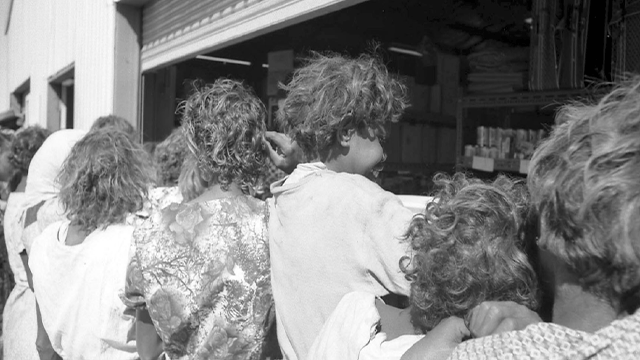
‘Shopping at Yuendumu’. Credit: Nicolas Peterson
This will be an in-person only seminar.
In this talk, Emeritus Professor Nic Peterson will consider the paradox of welfare autonomy in remote Australia. The government believes lack of waged employment in remote Australia is the most important policy issue. This suggests that the underlying concern is with poverty. Without entering a lifetime of wage labour, on the same basis as other Australians, remote Aboriginal people will always have a substantially lower standard of living than most Australians. Other underlying concern appears to be the level of social problems in communities, boredom and dependency, The frustration and challenge for government is the failure of the remote Aboriginal population to engage fully with the world of wage employment as the economic basis of their daily life. The frustration is manifested by the fact that since 1968 there have been six employment policies[i] for remote Australia, with no substantive change in the levels of employment. Most non-anthropological writing about this situation by social scientists lacks substantive explanation for this situation because they fail to recognise that there are distinctive social orders in remote Australia, the nature and influence of which are not fully evident even to the non-Aboriginal people who work in them. Among other things these social orders problematise the notion of dependency, pose complex moral and practical issues for policy, and make consumerism a powerful lens through which to views the intercultural issues and relations involved.
Speaker:
Emeritus Professor Nicolas Peterson is a Professor of Anthropology and a Fellow of the Academy of the Social Sciences in Australia, and an Emeritus Professor at the Australian National University’s School of Archaeology and Anthropology. His research is focused on land and sea tenure, Aboriginal engagement with the Australian economy, history of anthropology and photography of anthropological subjects. Nic started living in Aboriginal communities in remote Australia in 1965, initially with Yolngu people in Arnhem Land who were self-provisioning and subsequently with Warlpiri people at Yuendumu for thirteen months in 1972-3. Since then, he has been in contact with both communities and many others down to 2020.
In-person: H.C Coombs Building, H.C Coombs Building, Seminar Room C, Ground floor (near Coombs Lecture theatre)
Location
Speakers
- Emeritus Professor Nicolas Peterson
Event Series
Contact
- Kirsty Wissing