
(Image supplied)
In 2024, Chip Colwell and I convened a Wenner-Gren Seminar that scrutinised the Foundation's ethical obligations in connection with the Foundation's legacy casting program, Anthro-Cast, a profit-generating enterprise that the Foundation ran between 1962-76 (see Colwell and Rutherford 2025)1. The technology was revolutionary at the time. Anthro-Cast staff travelled the world making moulds of important fossil discoveries, which they used to make "patterns," artificial originals, that would allow them to produce countless numbers of casts.
In this talk, I will discuss the history of Anthro-Cast, the insights that came out of the Seminar, and the specific steps we are taking to reckon with the program's legacy. Anthro-Cast played a role in advancing the study of human evolution. Humans in the locations where the originals were found — in Asia, Africa, and the Middle East—rarely had a chance to participate in research on our species' past. The best-selling items were replicas of the remains of contemporary human individuals, which were used as references. They didn't consent to this treatment, nor did their descendants. We can't undo this history, but we can let it inform how we move forward.
Danilyn Rutherford is an anthropologist and author. She began her career as a visiting tutor at Goldsmiths College, before joining the faculty at the University of Chicago, then the University of California, Santa Cruz, where she was professor and chair. Her early work focused on the Indonesian-occupied West Papua, a troubled territory on the eastern half of New Guinea. More recently, she’s been exploring the social worlds of young people with severe and profound intellectual disabilities in the United States. Her interests are broad and eclectic. She has written on kinship, Christian conversion, disability, nationalism, sovereignty, missionary language ideology, Franz Kafka’s “In the Penal Colony,” affect, money, technology, climate change, and Cormac McCarthy’s The Road.
1 Colwell, Chip and Danilyn Rutherford. 2025. Grappling with the Legacies of Anthro-Cast: The Work of Bones in the Age of Mechanical Reproduction. Current Anthropology 66 (1).
ZOOM DETAILS:
https://anu.zoom.us/j/83676628890?pwd=A1IBLli8x0yuaR4ZA1hZOvSzWWFbNC.1
Meeting ID: 836 7662 8890. Passcode: 529408.
Location
Speakers
- Associate Professor Danilyn Rutherford, Wenner Gren Foundation
Event Series
Contact
- Anna Florin
Image Gallery


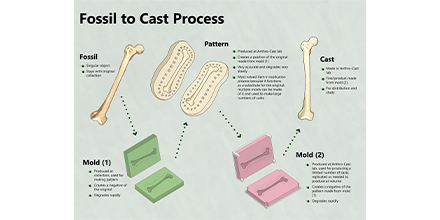
Anthro-Cast timeline (Image supplied).